The World Health Organization has a list of:

“Web sites that provide information on vaccine safety and that adhere to good information practices. While many quality web sites offer science-based information about vaccine safety, others may provide unbalanced and misleading information. This can lead to undue fears, particularly among parents and patients.” Continue reading

Posted on by Thoughtscapism | 2 Comments

Organic vs Conventional Food

IMG_5926

My balcony garden: artificial fertilizer, no pesticides, low yield, tasty results. Joy of gardening is the biggest plus. We’re lucky we don’t need to rely on balcony gardening for our five a day. Photo by Thoughtscapism.

This piece has also been published by the Genetic Literacy Project and the Fitness Reloaded blog.

I spent over a decade of buying little else than organic food. During that whole time, I never justified my choice by claiming that non-organic vegetables were less nutritious or somehow less healthful. (I just thought that the environment was better off with organic farming. That is another story: Natural assumptions and On farming, animals, and the environment.)

It was first a couple of years ago that I became aware of people claiming that organic produce would somehow possess a superior wholesomeness. I was confused, and when I learned of an extensive meta-analysis (‘The Stanford Study’) which had concluded there was no nutritional difference between conventionally and organically farmed food, I wasn’t fazed. Why would there be a difference? Continue reading

Posted in agriculture, health, nutrition, organic | Tagged , | 7 Comments

The Simple Math of Herd Immunity

I have often come across claims that wish to contest the existence of herd immunity. I find these puzzling. First of all, they are usually offered without proof. But mostly what befuddles me is that the argument approaches the topic backwards. It starts at the wrong end. Let me explain.

No herd immunity-

There is a simple way of breaking down the factors that make up herd immunity.

Continue reading

Posted in health, medicine, vaccines | Tagged , | 35 Comments

Myth: No Studies Compare the Health of Unvaccinated and Vaccinated People

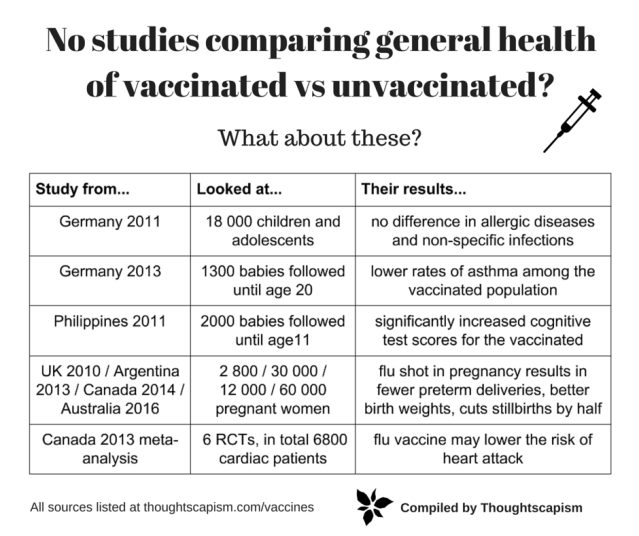
I’ve heard this claim several times. Ever since I found out that it is not true, I have been amazed how it just keeps resurfacing. I would like to put this myth to rest. I am aware of at least seven original research papers and one meta-analysis (looking at another 6 randomised clinical trials or RCTs) published since 2009 which look at myriad aspects of general health, comparing large unvaccinated and vaccinated populations. I will lay them out below, but to put it shortly: vaccinated people are as healthy or healthier in all aspects compared to the unvaccinated. The vaccinated populations studied have fewer vaccine preventable diseases (may seem obvious, but nevertheless needs to be mentioned), fewer cases of asthma, fewer heart attacks, better birth outcomes, and higher cognitive scores than their unvaccinated counterparts. To note, the incidence of autism is also unchanged in populations with or without the MMR vaccine – more about that in a piece of its own, The great myth of vaccines and autism.

Vaccinated vs unvaccinated (3)

All studies listed at the end of this post

Continue reading

Posted in health, medicine, vaccines | Tagged , , , , | 62 Comments

The Intriguing Case of Narcolepsy and Swine Flu

I thought this was an interesting story to follow – it’s about Finland (where I’m from), and the connections between narcolepsy, influenza and the influenza vaccine.

The season 2009-2010 saw the global sweep of the Swine flu pandemic, which infected between 10 – 200 million and is estimated to have killed approximately 18 500 people. What was unusual was that many young and middle-aged people in good health were amongst the hardest hit. Interestingly, a study published in Nature Medicine indicates that young people were dying because of the excessive response of their own immune system – Continue reading

Posted in medicine, vaccines | Tagged , , | 3 Comments

GMOs and the Environment

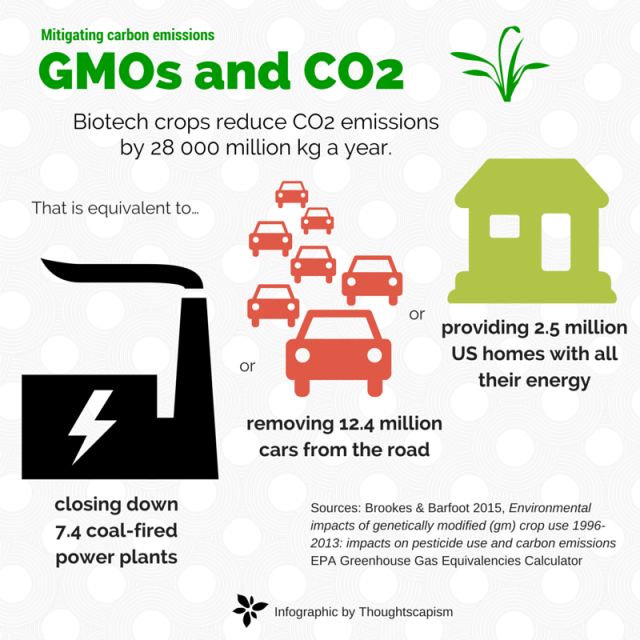
Many people are worried about the impact GMOs could have on the environment. That’s a reasonable concern. Are GMOs increasing the profits of farmers and biotech companies at the expense of the environment? As I have learned more about biotechnology and agriculture, contrary to popular fear, I have found that there is actually no scientific evidence of  harm from GMOs – but it doesn’t stop there. Conversely, I have learned that there are several environmental benefits of biotechnology.

GMOs and CO2 updated

Continue reading

Posted in agriculture, climate, environment | Tagged | 22 Comments

Is There a Consensus about Climate Change?

There are a great many people who hold contrary opinions on climate change. Most of those people are not climate scientists. But there are even many climate scientists who hold contrary views to each other. Myriad blogs and news sites can help reinforce one’s view, be it that human induced climate change (or AGW – Anthropogenic Global Warming) is happening or not.

So how can we, non-climate scientists, know if climate change is happening, and if it is caused by human activities? Continue reading

Posted in climate, consensus, environment | Tagged | 10 Comments

Energy Solutions in a Changing Climate

DSC01343

Reflections. Photo by Thoughtscapism.

Many people respect the views of the International Panel of Climate Change (IPCC) on the state of the climate – at least roughly half of the global population perceives global warming as a threat. Most of them whole-heartedly acknowledge that we need to take action to mitigate climate change. The odd thing is, though, that a great many seem to ignore a significant portion of what the IPCC is saying when it comes to climate solutions. Continue reading

Posted in climate, energy, environment, nuclear, renewables, science | Tagged | 8 Comments

Following the Money

IMG_5497

I thought this trail would lead me to the unicorn’s lair, but sometimes our intuition doesn’t match the reality.

Many people are concerned for the corporate profits from vaccines.  I’ve often encountered the arguments “Vaccine research is conducted by Big Pharma and cannot be trusted” and “Vaccines serve mainly to increase the profits of doctors and medical companies”. These arguments should be taken seriously. How can we try to find out if we have reason for concern? How could we make sure conflicts of interest will not lead to harm? Continue reading

Posted in alternative medicine, finance, health, medicine, science | Tagged , , , , , | 11 Comments

On Farming, Animals, and the Environment

IMG_1935I have written about my journey going from an enthusiastic organic supporter to a reluctant avoider of organic products in my piece Natural Assumptions, and afterward I received harsh criticism from one organic farmer. I have learned my lesson about remaining open to evidence, so I wanted to take the opportunity to review his points carefully to make sure I had not been too hasty in my conclusions about organic farming. (This piece was originally published in February 2015 and updated in April 2016.) In a three-part series of posts, I will offer my response to the criticism posted on the comments section of the Skepti Forum Blog by Rob Wallbrigde (who blogs over at The Fanning Mill). I thank him for his interest in civil debate, and for providing me with a detailed 6-point list of issues he saw with my piece, making this discussion possible. I will go into more detail on the aspects of 1) nutritional content, 2) animal welfare, 3) pesticides, 4) environmental impact, 5) yield differences, and 6) the origins of organic farming. The answers got lengthy. The two last points are dealt with in a post of their own, Delving deeper into the roots of organic.
Continue reading

Posted in agriculture, environment, nutrition, science | Tagged , , , , | 32 Comments